
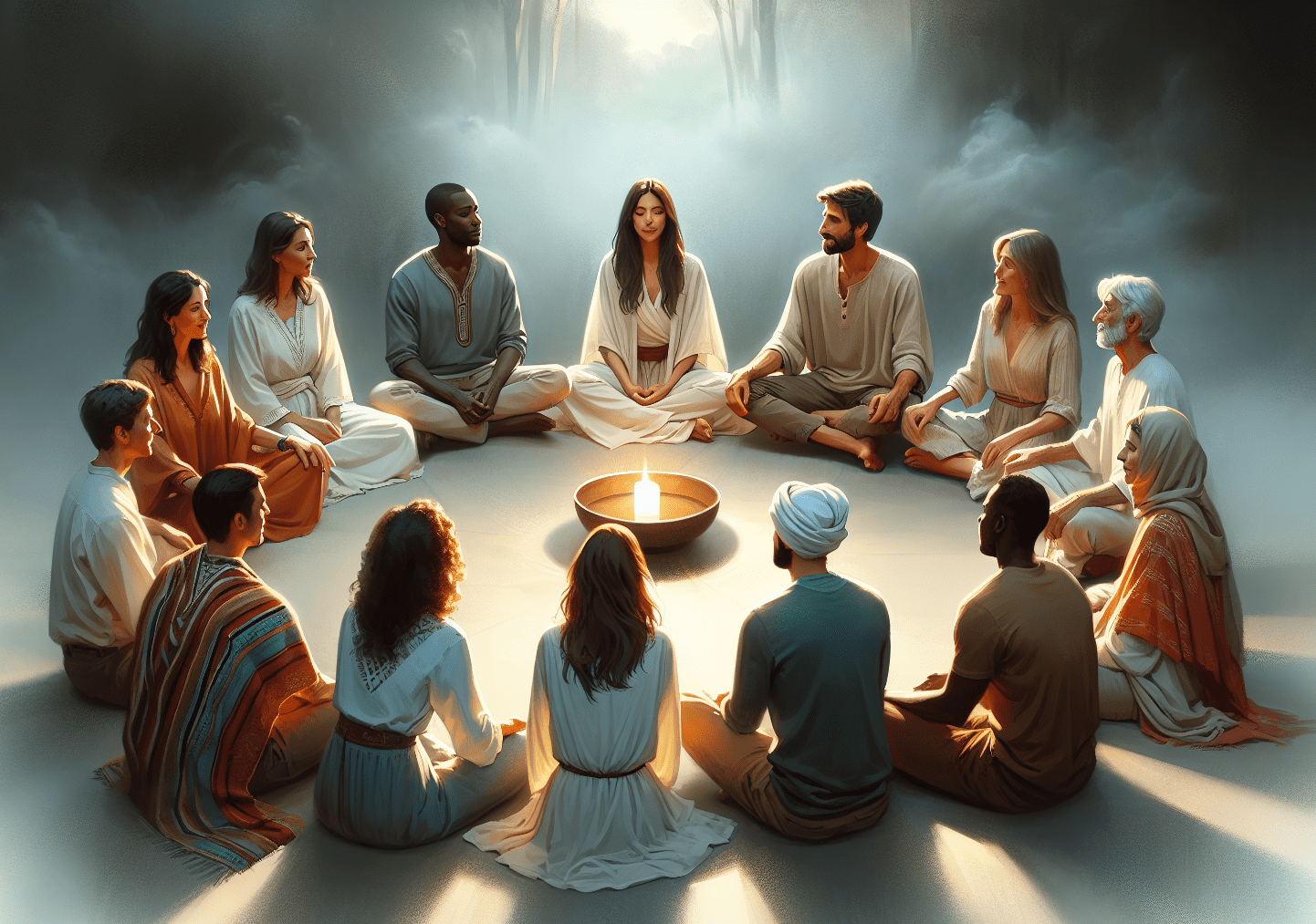
By virtue of being human, all of us have spiritual experiences of awe, wonder, insignificance, mercy, redemption, forgiveness, sacrifice, oneness, and more. These may be some of the most profound experiences of our lives. But if we are not a member of a specific religion, we may have no way to share those experiences with others. And even in many religions, the spiritual experience may be primarily one of receiving, rather than sharing what is within us.
The chalice circle practice is designed to help us to share these universal spiritual experiences together, no matter what our religious beliefs may be. The purposes of this post are to fully explain what chalice circles are, and to encourage you to join or start one with friends.
Briefly, a chalice circle is a group of about eight people who get together regularly to share their own experiences on a different spiritual topic each month. Members take turns leading. In the presence of equals, it is a privilege to hear about the most sublime moments of other people’s lives and it is validating when they listen to ours. Indeed, when our beliefs don’t align with others in the group, a chalice circle can be even more enriching, because we may be exposed to new wisdom as we hear what others say about their lives.
For example, I am an atheist, and yet chalice circles have been a primary spiritual practice of mine for nearly twenty years. Currently I “convene” one circle (see below), I participate in another, and I am hoping to help launch a program of chalice circles at First Parish of Sudbury, a Unitarian-Universalist church. Partly to prepare for that role, but more directly to satisfy what I hope is a latent interest of yours, Gentle Reader, I decided to write a post about chalice circles. It is a very tender topic and I hope you will receive it with tenderness.
What chalice circles are
How can people with different beliefs share their spirituality? Chalice circles have evolved as a way to do this. That’s why I refer to it as “spirituality for everyone”. Proceeding from the general to the specific, there are four practical aspects to be addressed: commitments, scheduling, conducting a session, and topics.
Commitments. Members of a chalice circle agree to a written covenant of their own choosing. A covenant is a solemn agreement among equals for mutual benefit. A well tested example is available here. The group can change their covenant as they see fit. Chalice circle covenants have evolved over time, but they generally include three essential components that make the format work for everyone.
The first commitment is to prioritize attendance. Whatever schedule the group agrees to, members commit to doing their best to show up. Some circles may decide to suspend sessions for the summer, or to decide each month whether to move the next session to a better date, but all members accept an obligation to attend if possible by giving priority to the chalice circle.
The second commitment is to complete confidentiality while the chalice candle is lit. Spiritual topics are very sensitive and we will not say what we yearn to say if we imagine that it could go beyond the circle. Trust is essential and it is strengthened over time. I’ve seen a breach of this trust destroy a circle. If your spouse asks, “how was our mutual friend Alice at your chalice circle tonight?”, the most you can answer is, “before the chalice was lit, she was quite upbeat.” You cannot say, “after the chalice was lit, she disclosed that she has breast cancer.” That disclosure is up to Alice, not to you. What you share within a chalice circle is sacred among you. This in itself is an important spiritual practice. Be worthy of the trust placed in you.
The third essential commitment is, “no crosstalk”. Crosstalk has two forms. The first is an interruption. In a session, each person takes a single, continuous turn speaking about the topic without any interruption. They may pause to think, perhaps for a long interval in order to form their thoughts, but until they say they are finished, no one else is to speak. If someone else speaks, and people do forget from time to time, a finger to the lips or a murmur of “no crosstalk” is helpful. When someone is speaking, we give them all the space in the world and we just listen deeply. However, murmurs and gestures of sympathy, laughing together, etc., are all entirely appropriate and do not constitute crosstalk. Crosstalk is talk. The second form of crosstalk to be avoided is subtle debate. It’s okay to say, “I see it this way …”, but it’s not okay to say, “in contrast to Alice, I see it this way …”. Chalice circle is not a conversation or a debate—it has no resolution or consensus. We allow an exploration by each person in turn, while others witness and accept that exploration. The commitment against crosstalk may seem awkward and uncomfortable at first, but it creates a very special safe environment. It’s almost like meditation—people become calm and present, their heart rate and respiration slow down. In that environment, we give and receive spiritual nourishment without fear. Every emotion can come to the surface and be treated as precious by all.
Scheduling. Monthly seems to work out well. Same day of the week, same week of the month, same time. So for example, “third Tuesday at 7pm”. For some people, that’s straightforward, but not for many parents. Usually both parents want to join together, but that creates a difficult and expensive childcare problem. Here are three avenues to consider. 1) Join different circles, so you can trade childcare duties on different nights. 2) Create or join a group of other parents who meet when children are at school or when a different member can watch all the kids each month. 3) Meet remotely. Online chalice circles are easier to attend, but you may want to start out with a few in-person sessions to establish some bonding.
For scheduling topics each month and hosting at home (if not remotely), I recommend an alphabetical rotation system. If the one whose turn is approaching cannot meet their commitment, they should reach out to swap turns with another member. In any case, there will need to be a little bit of ongoing administration. Whose turn is it to give a topic next month? Who keeps track of swaps? Where will we meet, or who will host the online session? Who sends reminders a few days before? Who tracks down people who haven’t replied to a reminder?
Most chalice circles elect a “convener”, who keeps track of the schedule and sends out reminders each month. The convener basically ensures that the meetings occur. If there is a convener, I suggest that the role be annually elected. This prevents a “convener for life” from dominating a circle. In my view, a convener should be careful to do the minimum work necessary to ensure that the circle meets and no more. I plan to write a separate addendum with advice especially for conveners. When it’s done it will be linked here.
Conducting a session. Each session follows the same sequence. Briefly:
- The current topic provider calls the circle to order by lighting a chalice flame (candle?), usually with some ritual invocation that they like.
- Each member takes a turn “checking in”, which means taking about five minutes to share how they’re currently feeling and why.
- The topic provider introduces the topic, first by name, then perhaps with evocative quotes, then by asking specific questions.
- After a period of silent contemplation each member takes a turn speaking to the questions. There are no interruptions.
- After everyone has spoken, some groups ask, “anything more?” and more uninterrupted comments may be made. If so, It’s particularly important to avoid debate.
- The provider may give some closing quotes on the topic.
- “Check out”. Each member has a chance to comment on their experience, perhaps thanking the topic provider or noting things that they learned.
- The chalice flame is extinguished, perhaps with some closing invocation.
- Business is attended to. Who’s next and when? Feedback and changes?
Topics. The variety of subjects that can elicit shared spiritual feelings is extraordinary. Fortunately when our turn comes to give a topic, we don’t have to start from scratch. There are hundreds of possible topics and session plans on the UU Small Group Ministry website. When my turn comes, I usually modify something that I find there. And some topics bear repeating from time to time. For example, one group does “gratitude” each November in honor of Thanksgiving. Every topic provider leads a little differently and this adds to the richness of the repeated sessions.
Encouragement
It might seem a bit scary at first, (it was for me), but I think everyone will benefit from participating in a chalice circle. After all if I, an atheist, can enjoy that benefit, then perhaps no one is beyond the all-accepting warmth of the circle. I wish it were as easy to find a chalice circle as it is to find a yoga or meditation class. Chalice circle is not about agreeing, or measuring up, or fitting in, or being converted; it’s about letting your soul sing its true song aloud and discovering that others cherish your words. And learning that you cherish each song of their soul as well.
Do you know the metaphor of “Indra’s net”? Indra is a god in the Hindu pantheon. The story is that Indra made a fishing net and at each junction, he placed a unique jewel of extraordinary beauty. If you were to look closely at any one of these jewels, not only would you be astonished by it’s indescribable beauty, but within it, you would see even more—the reflected beauty of every other gem in the net. We are the jewels of Indra’s net. And chalice circle is where we can look deeply into a few of those precious jewels, one at a time. And we see ourselves as one of them.
If you have questions or comments about chalice circles, I ask you to share them below. That way, everyone else will benefit from the discussion. All comments come to my inbox, so I’ll be sure to reply as well as I can.
Colophon: the image for this post was generated by a WordPress AI in response to my completed text. I’m impressed.

