
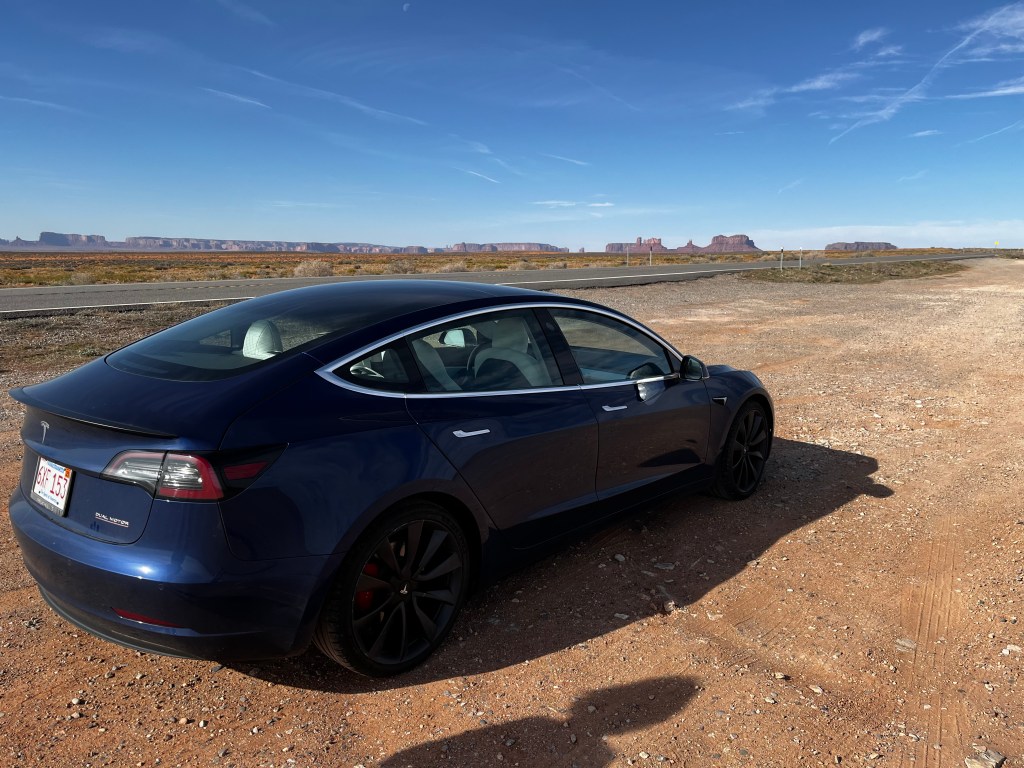
Starting in April of 2023, Bridget and I spent 35 days on vacation, driving across the USA. Many people have toured the country by car and there is nothing new to report about that, so I won’t bother describing the wonders of our national parks, etc. (I assume, Gentle Reader, that you are relieved to hear this.)
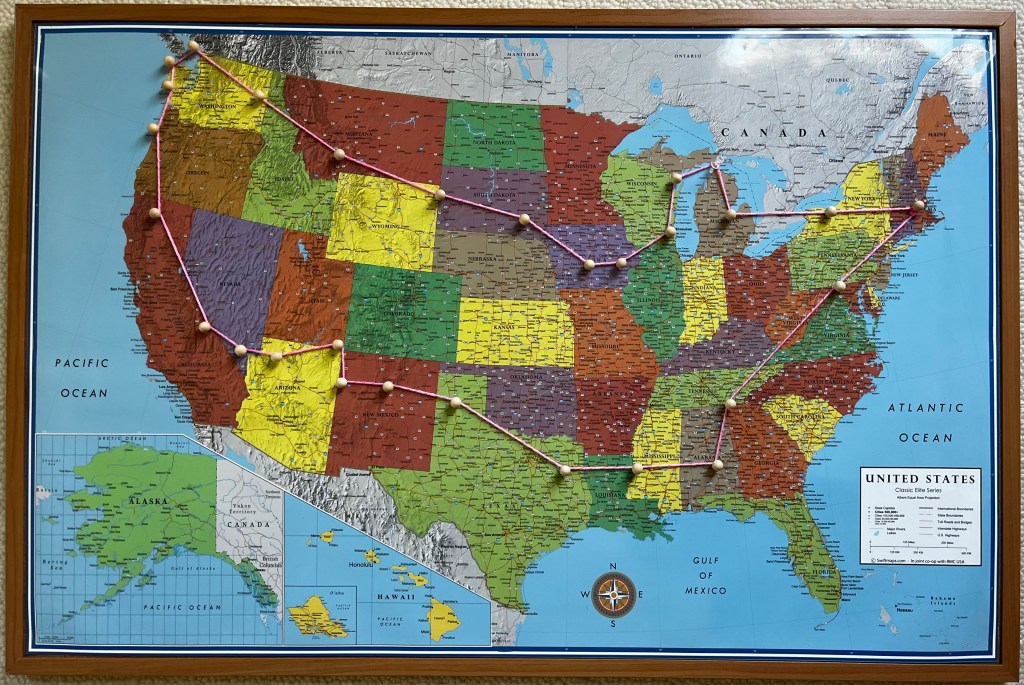
But we made the trip in a fully electric vehicle, a 2020 Tesla Model 3. There is plenty of news to report about that kind of trip, starting with the fact that it can be done. Every time I’ve mentioned this trip, people have been curious about many aspects of it, so I decided to write a post about it, concentrating on how the EV experience was different from the traditional road trip. In summary, it was a mixture of futuristic pleasure and nerve-wracking anxiety. It was certainly dramatic. Below is a map of our path, clockwise from Boston, with a pin every place we spent the night.
Planning and preparing
Syrupy nostalgic digression. The great American road trip is part of the lore of my family. My parents’ honeymoon was a month-long camping trip across the USA between college terms. Their grainy photographs came from a Brownie camera. There’s my mom feeding a peanut to a chipmunk in Yellowstone Park. (Too smart to feed a bigger animal, I guess.) Barely 20, she’s wearing the teenage uniform of the day: rolled-up dungarees, checked flannel shirt, white socks and penny loafers. I’m not even a gleam in her eye. There’s the famous episode where my dad, the Eagle Scout, pitched their tent in a dry wash in Arkansas, only to be flooded out in a midnight thunderstorm. (The dads always get it in these stories, don’t they?) And then my brother did “the trip” at their same age, but solo, on his motorcycle—Born To Be Wild, bro! But I’d never done it. One of the things I dearly love about Bridget is that, when I dream aloud, she starts scheduling. Before I know it, we’re doing it.
Back to the EV part. It wasn’t my first road trip in the Tesla. I took a solo four-day trip from Boston to South Carolina and back, which proved to me that a longer trip should be a comfortable experience. On that SC trip, I learned to drive for two hours, then charge for half an hour, then repeat. In four cycles spanning ten hours, I could comfortably cover nearly 600 miles in a day. Three factors made this easier than in any other car I have ever driven.
The first was the rests imposed by the mandatory half hour breaks to charge up. I’d get out, stretch, walk around, pee, get a soda or an iced coffee, sit in the car to plan my next leg on the NAV system. It felt great. The second factor was “AutoPilot”, which is not to be confused with “Full Self Driving”. AutoPilot is just adaptive cruise control and lane-keeping steering. Other cars can do this. It reduces the cognitive burden a lot to let the car stay in its lane, keep a constant speed, and not ram the car ahead. I pay attention, but that’s way less work than all of that manual lane-keeping and speed-keeping. The third factor is that there is no engine drone and the wind and tire noise are pretty quiet. So it’s pretty calm in the cockpit. The shakedown trip was so easy. (Am I being too heavy on the foreshadowing here?)
Charging down the road
You may have wondered why I was charging every two hours. That’s about every 140 to 150 miles. But you’ve probably heard that these EV cars boast(?) a range of about 300 miles. What gives? Well, my particular car says it has a range of 280 miles when it’s 100% charged. But my real range drops a lot due to extra wind resistance if I travel faster than the speed limit. I normally set my cruise control at 8 mph over the limit, so that’s 78 mph on most highways south of the Mason-Dixon Line. That drops my actual “100% range” down to about 240 miles. Yes, it’s a big loss just punching faster through the air.
But wait, there’s more (less?). Charging proceeds very rapidly up to 80% full, then it slows down dramatically to protect the battery, so getting the last 20% takes another half hour. It saves time to unplug and get back on the road at 80%. So then my real starting range is about 200 miles. And I don’t want to arrive at the next charger with zero charge left. What if it’s broken or out of service? I want at least enough charge remaining to get to the nearest alternate charger. So I want to arrive at the planned charger with about 30 to 50 miles of range left, which is 12% to 20%. So every two hours, I’m driving from 80% down to 20%, then charging back up to 80% in half an hour. This is the fastest way to proceed in that car without the risk of being stranded with no charge left. By the way, if that happens, you need to get towed on a flatbed truck to the nearest charger and then you’ll be back on the road 40 minutes after you plug in. Apparently some people do this pretty often, but I hope I never will. Maybe they want to meet tow truck drivers.
The NAV system knows where all the Superchargers are and it automatically selects a sequence of charging stops for me. For example, if I’m at home near Boston and I just say to the car, “navigate to Montgomery, Alabama”, here is what it shows me.
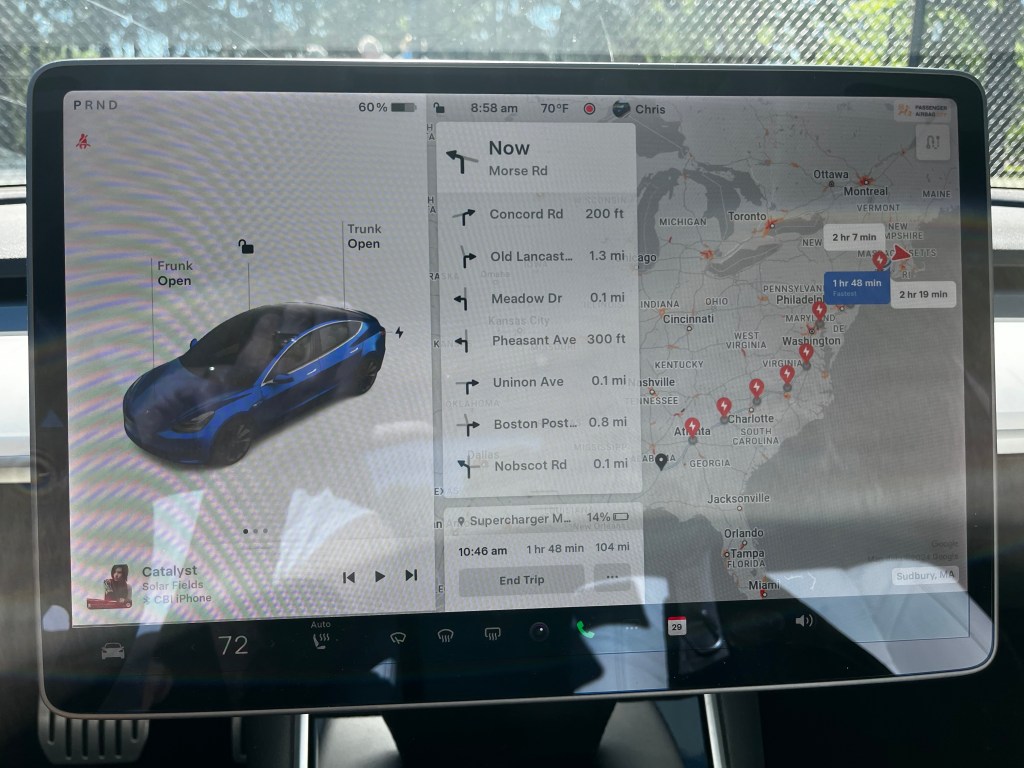
Notice that it has picked a series of Superchargers along the route. They will all be within a mile or so of the highway and the NAV system will not only direct me to within sight of the stalls, but it will also precondition the battery as I get close, for faster charging. The lesson is, always navigate to a Supercharger on your trip.
Tesla’s Supercharger network may be the company’s greatest asset. They are strung like pearls along every interstate highway, spaced every 50 miles or closer.
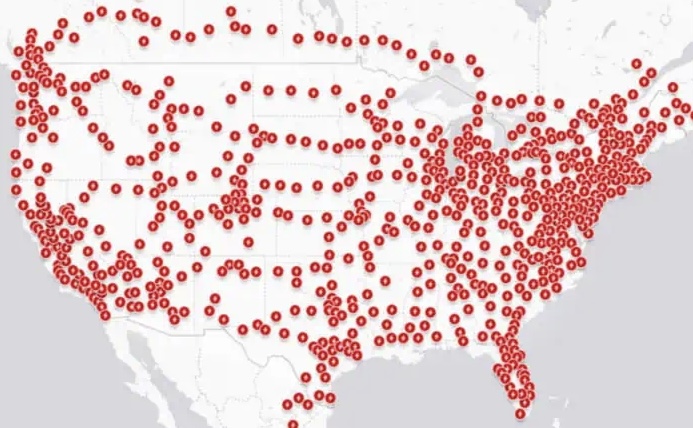
This map is what allowed me to conclude that our trip was possible. But it’s even better than it looks. At each charger location, my car map shows me how many stalls are actually open and functional, in real time. This is light-years ahead of the competition, where their density is low, their charging speeds are mostly uselessly slow, and you often arrive to find that their charger is dead and there isn’t another one nearby. I do not exaggerate. On our trip, I used about a dozen non-Tesla chargers, but I tried more than two dozen. That’s right, fewer than half of the non-Tesla chargers I tried were functional. They were vandalized, or shut off, or unable to connect to my phone, or unable to communicate with my car, or unable to process my payment. It was ridiculous. Let me be clear: in 2024, I would NOT try an EV road trip without Supercharger access. Unless you want to meet tow truck drivers.
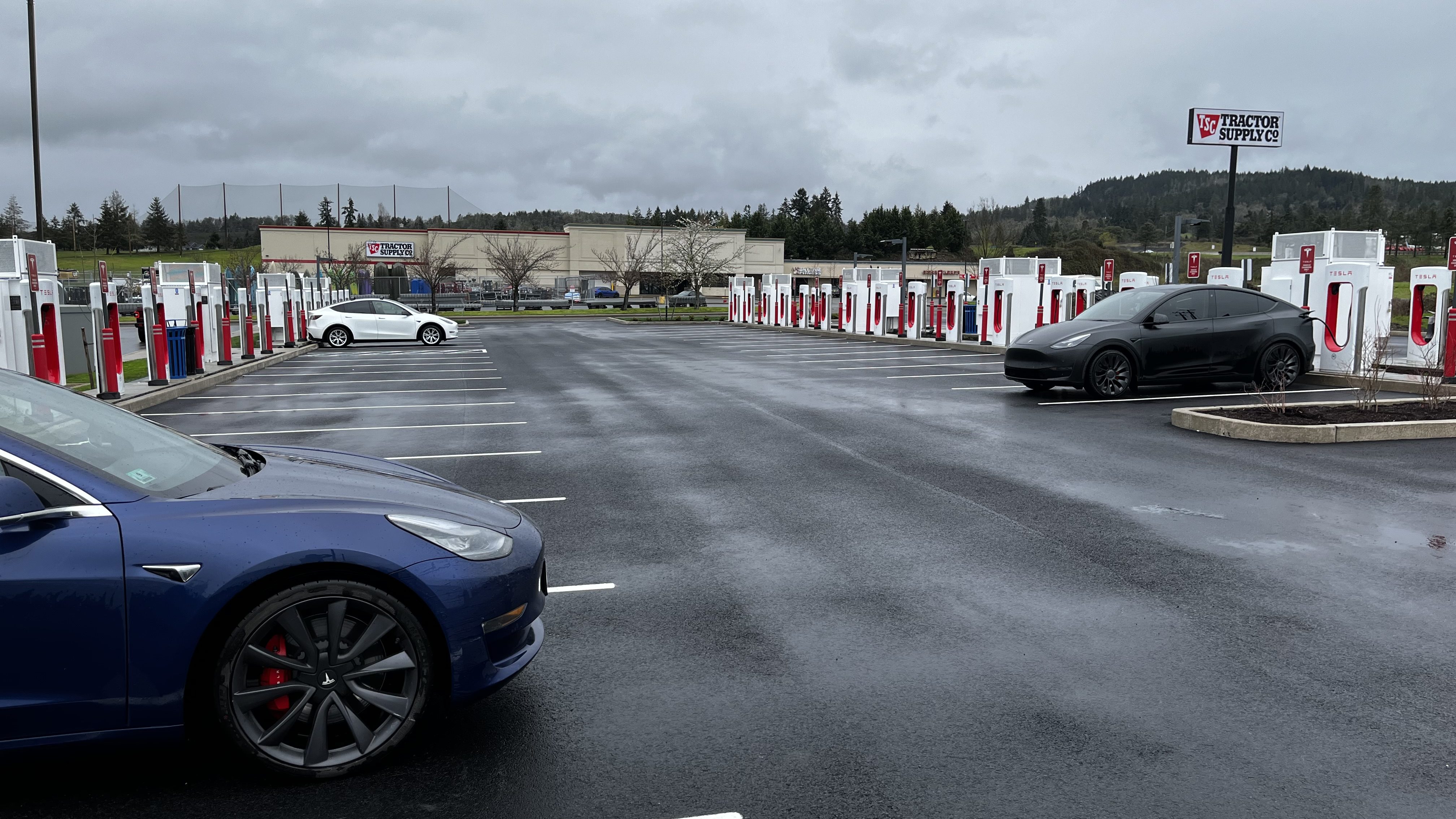
By contrast, the Supercharger experience is so smooth. Here’s the procedure. Step 1, back into the parking space. (This is the hard part.) Step 2, just plug in. There is no step 3. In all of the hundred or so episodes of Supercharging on our trip, only one or two Superchargers ever failed us. The solution was to just move to the next parking space. In Sutherlin, OR, (below) there were fifty others to choose from. This is the biggest station we stopped at. Why so big in such a small town? It’s halfway between Silicon Valley and Seattle.
That said, there are still places we couldn’t go. We wanted to go from Vicksburg to Little Rock, but there are no chargers of any kind going north along the Mississippi River there. So we skipped Arkansas and went through Texas. The whole Four Corners area of the Southwest, with all of its spectacular national parks and Native American sites, is barren of chargers. Really, Elon? You think no one wants to go there? After three days of determined research in advance, I turned up an obscure public charger in Bluff, Utah, which allowed us to visit Monument Valley, the ultimate car commercial location. Not for EV’s though, unless they tow them there. As a Yankee is alleged to have said, “ya can’t get theah from heah.” And last but not least, look at the Dakotas on the map above. EV’s can go east-west, but not north-south. There is a famous birding hot-spot on the southern border of South Dakota. The birds can migrate north-south and refuel there, but a Tesla cannot. We had to skip it.
Desperately seeking electricity
In a few years, this will all seem cutely nostalgic, like stories of your grandparents laboriously driving to their vacations without any interstate highways. But for now, the intrepid EV road warrior has to be ready to stick a plug into the darnedest places. (Eww.) Like, using a dryer outlet at an AirBnB; or renting an RV “hookup” for a few hours; or, when all else fails, plugging into a humble 120 volt outlet to gain a measly 4 miles of range per hour. (Bridget’s hybrid RAV4 is doing that overnight as I write this. Tomorrow it will have its maximum of 50 miles of pure electric range, enough for a trip to “town” without burning any gas.) To prove that I’m not exaggerating about the challenge, here is a photo of the charging adapters I carry in my Tesla.
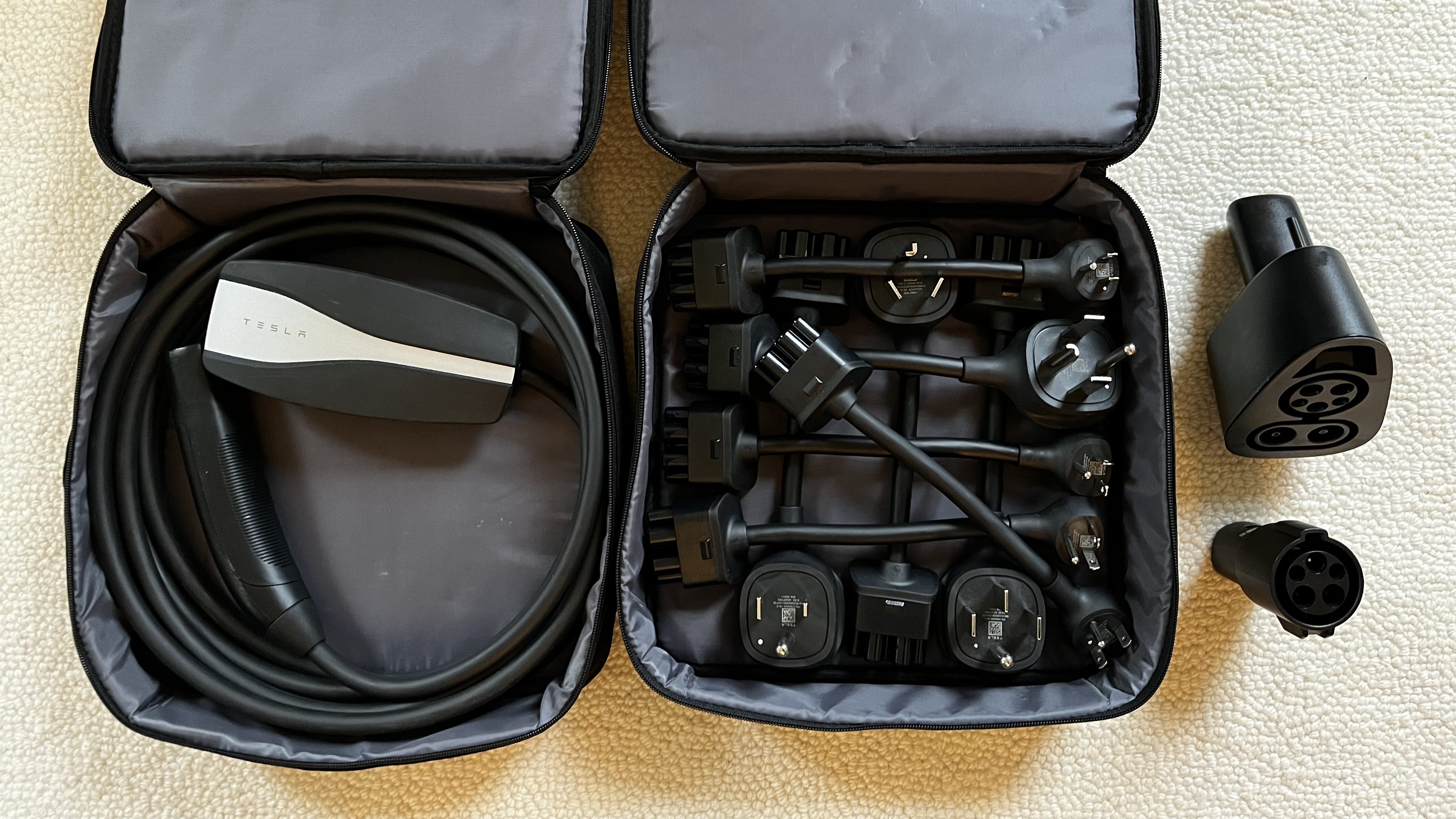
On the left is my charging cable for electrical outlets. In the middle are all of the plugs that the box on the left can use. With that equipment, I plug into standard electrical outlets and gain range at anything from 4 miles per hour up to 30 miles per hour. On the right are two adapters to connect non-Tesla EV charging cables to my car. The one on the bottom is a J-1772 adapter, probably the most common 240 volt AC charger plug in the US. A lot of municipal chargers are of this type and the fastest version I’ve seen will charge my car at 20 mph. On a road trip, J-1772 chargers are only good for overnight recharging, assuming they don’t mysteriously shut off at say, 8:30pm. (By the way, 120 volts AC is called “Level 1”, 240 volts AC is called “Level 2”, and high voltage DC is called “Level 3”.)
The honking big adapter on the top right allows me to connect to fast DC chargers that have CCS plugs. (DC chargers include Superchargers, CCS, and CHAdeMO varieties.) Buying this expensive adapter in advance is the only reason we could visit Monument Valley. The public CCS charger in Bluff, Utah charged my car at Supercharger speed: over 600 mph. I also lent the adapter to a fellow patron at our hotel that night. He was trying to get his Tesla from Salt Lake City to Albuquerque, which basically can’t be done without this adapter. He handed me his phone as security, which tells you how desperate he was.
I don’t have a (costly) CHAdeMO adapter because most non-Tesla DC chargers deploy both CCS and CHAdeMO on the same charging station. Besides, who wants to spend money on something called “CHAdeMO”? It reminds me of a Frank Zappa song:
“I poked ‘n stroked ‘til my wrist got numb,
But I still didn’t hear no CHAdeMO Humm.”
Frankly, the sooner every car-maker adopts the Tesla “zapper” (rebranded NACS), the better. Many companies have already done so, and I’m confident more will follow. Imagine if your car could only fill up at some gas stations whose pump fit your car. Imagine you sometimes had to scrounge gasoline by siphoning from lawnmowers. Sheesh.
Quadruple whammy on the road
“And suddenly there was a terrible roar all around us and the sky was full of what looked like huge bats, all swooping and screeching and diving around the car, which was going about a hundred miles an hour with the top down …” Yes, that’s my favorite line from the first paragraph of Hunter S. Thompson’s “Fear and Loathing in Las Vegas“. We didn’t see the bats, but …
Whammy #1. On the morning of Day 3, as we crossed into Central Time on I-59 in Alabama, the car slowed down to 63 mph and popped up an alert, shown below.
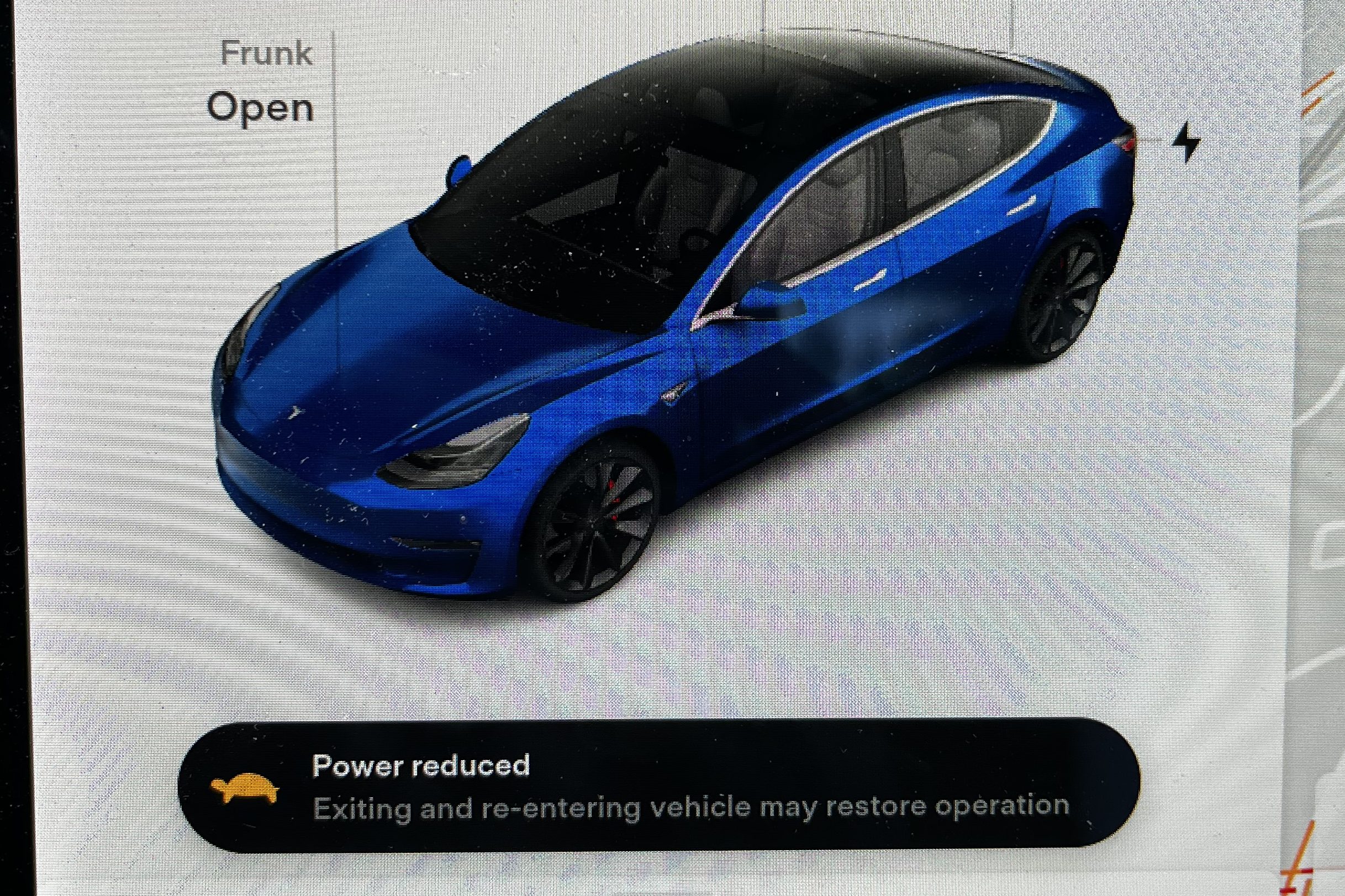
“Exiting and re-entering …”? Are you kidding me? Sounds like an old MicroSoft Windows joke. It being Sunday morning, we pulled off into an empty Dunkin (Donuts) with no town nearby and dubiously tried the advice. To our mixed surprise, relief, amusement, scorn, and nervousness, it worked. Sadly, rebooting your car is no joke any more. Back on the road at normal speed. We made it to the Supercharger in Birmingham, which must be a new one, because I briefly saw a charging speed of 956 mph! That’s about a third of a megawatt.
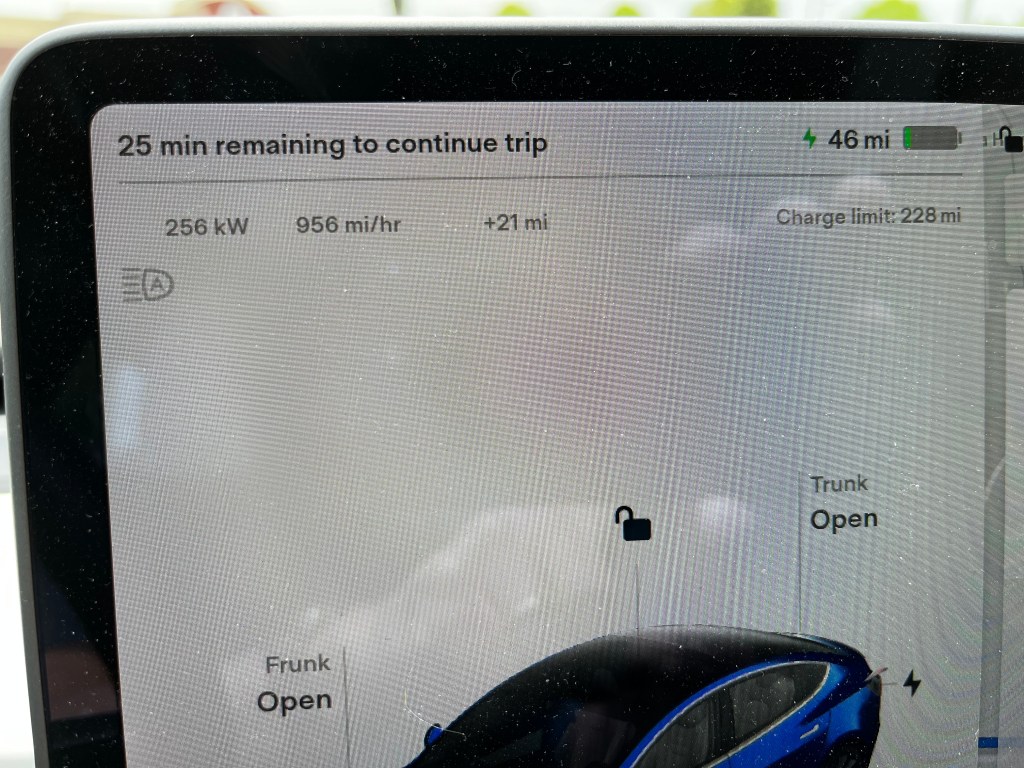
And we made it to Montgomery, our destination for the day without further delays. But our fears of the turtle were going to be justified later. Wait for it.
Whammy #2. A second problem had also cropped up in the last two days. The adaptive cruise control had slammed on the brakes several times for no reason. Beautiful day, straight road, no cars ahead, but wham!—panic stop by the car itself. It even has a name: phantom braking. Each time, I lunged to cancel the cruise control while over-riding the braking with my foot on the accelerator. WTF? This was really unnerving. We always had no warning. But on we went.
Whammy #3. On Day 4, the third problem emerged. It was raining and our first leg was on US80 west to the next Supercharger in Meridian, MS, a distance of 149 miles. Just a bit of a stretch, but it should be doable. But as we slogged along on the old two-lane road, our projected remaining charge at the destination kept dropping lower and lower. Before we reached Selma, less than 1/3 of the way, the projection had dropped from 25% to 5%. We weren’t going to make it. We stopped to re-plan. We could go back to Montgomery, recharge again and seek a more roundabout route westward, but we’d lose a day or more. Dammit, we had reservations at the Grand Canyon eight days from now. I searched for non-Tesla chargers within reach, but there was nothing. It’s rural Alabama. Okay, so Plan B was to detour along a bunch of 45 mph back roads from Selma to Tuscaloosa, where there was a closer Supercharger. Then take a medium-sized leg to Meridian. Two or three hours of delay, if it works. The range kept dropping as we wound our way in the rain to Tuscaloosa, but we made it to the Supercharger with 4% left. (Captain Spaulding says, “in Alabama, the Tuscaloosa, but that’s entirely ir-elephant to what I was talking about.”) Then we made it handily to Meridian, to Jackson, and to Vicksburg, our destination for the day.
What WAS that? Tesla in-car range projections are very fancy. They even include things like headwinds, elevation changes, and air conditioner usage. Most people report them to be spot-on, and so do I, under most circumstances. So what went wrong? I have a theory. Rain. Literally every raindrop that hits the car has to be sped up to 60mph, or whatever speed the car is going. It’s basic physics. At highway speeds, that’s a lot of extra drag. I think Tesla doesn’t factor that in; every raindrop comes as a surprise loss. And puddles create drag, too. You know that braking feeling you get when you plow into a puddle at high speed? Well, old US80 has shallow worn ruts miles long, with just a little water in them, but that water drags steadily at the car, causing the range projection to drop continuously, even on our detour to Tuscaloosa, since the Tesla projections keep on neglecting rain.
Why aren’t other cars affected by this? Well, an EV is about three times as efficient as a gas or diesel car, about the equivalent of 120+ miles per gallon. My car’s entire battery holds the amount of energy that’s in 2.2 gallons of gas. So my range depends very sensitively on having low loss of every type. If I stuck my hand out the window for a hundred miles, the wind pushing against my hand would increase my total loss by a big fraction, so my range would drop by a big fraction. But in a gas-powered car, there are already three times more losses always using up power, so my hand in the wind would hardly increase that big, continuous total loss by much, and therefore it would hardly decrease my range. This sensitivity to incremental losses is why the Tesla range projection has to be so sophisticated. And it’s one reason why EV’s get a reputation for not living up to range expectations. Needless to say, after the “Tuscaloosa episode” we were hypervigilant about range projections, writing them down and comparing them to actual results on every leg. The only times we saw discrepancies were in the rain.
Whammy #1 again. On Day 5 in Vicksburg we planned to drive a section of the Natchez Trace to Emerald Mound, a huge Native American earthwork. But the car immediately threw up another turtle alert about limited speed and acceleration. We tried the “get out—get in” trick to no avail. We charged at a Supercharger to no avail. So I called Tesla roadside assistance from the car itself. The service rep (in Las Vegas) was quite helpful. He could see my car’s error codes and knew that they were about overheating. When a hard reboot didn’t clear the alerts, he made a same-day appointment for us at the nearest Tesla service center in Brandon, MS, about an hour back east. Off we went at our maximum speed of 63 mph. The service center took us right away and found a low coolant level. They topped it up and passed a driving test. It was free. They even let us recharge free during lunch. I asked the coordinator what would have happened to our road trip if they couldn’t quickly fix the car and she said they’d have swapped us another Tesla for the remainder of the trip—four weeks and 8000 miles. Wow. So we drove on the Natchez Trace to Emerald Mound after all.
Whammy #4. What with the speed limiting alerts, the phantom braking, and the raindrop range drop, Bridget declared she was too anxious to drive the Tesla at all. We seriously considered scrubbing the trip, even flying home and shipping the car. Or shipping the car and continuing the trip in a rental car—anything but a Tesla. But after the positive experience at the service center, we were in higher spirits and we decided to continue. But I would do all the driving.
Whammy #2 again. (Are you keeping track? This one is the phantom braking.) Next day, Day 6, we set out across Texas. It was a beautiful morning and the cruise control was slamming on the brakes several times an hour. At one point, the car was slowly passing a semi while being hounded by a black Silverado. (What is it with black Silveradoes? They all seem so aggressive. Or are they just mortal enemies of Teslas?) Anyway, just as I had clearance and was easing over in front of the semi, the brakes hit full strength. I slammed the accelerator pedal and fought the steering as I disengaged the cruise control. In the rear view mirror, I saw the semi swaying very close. The Silverado roared past me with a horn and a rude gesture and was gone. Bridget said, “no more cruise control.” I agreed, “AutoPilot is trying to kill us.” So I drove the remaining 8000 miles without cruise control. When I got home, I filed a detailed report with the NHTSA.
Whammy #1 for the third time. An hour or two later, still on Day 6, we got another speed limiting turtle alert. We stopped in Lindale, Texas, and yes, it’s nowhere. We tried the “get out—get in” trick, but of course it didn’t work. I called Tesla again and got lucky—we were close to a service center in Tyler—not quite nowhere. So we limped to Tyler where the now-customary fabulous Tesla service staff took excellent care of us. But they needed to keep the car overnight. They were going to perform the Tesla equivalent of a heart transplant. (Cue the organ music.)
Everything about an EV is conceptually simple, except for one system: the cooling system. To get their very high efficiency, the heat transfer complexities required are Byzantine. The Tesla has a coolant system linked to a refrigerant system by two heat exchangers and innumerable pipes and control valves in a single metal/plastic manifold that’s about twice as complicated as a human heart. It has 14 modes of operation, all lovingly described in this 1+ hour video. And mine was malfunctioning. Here’s what one looks like, from each side.
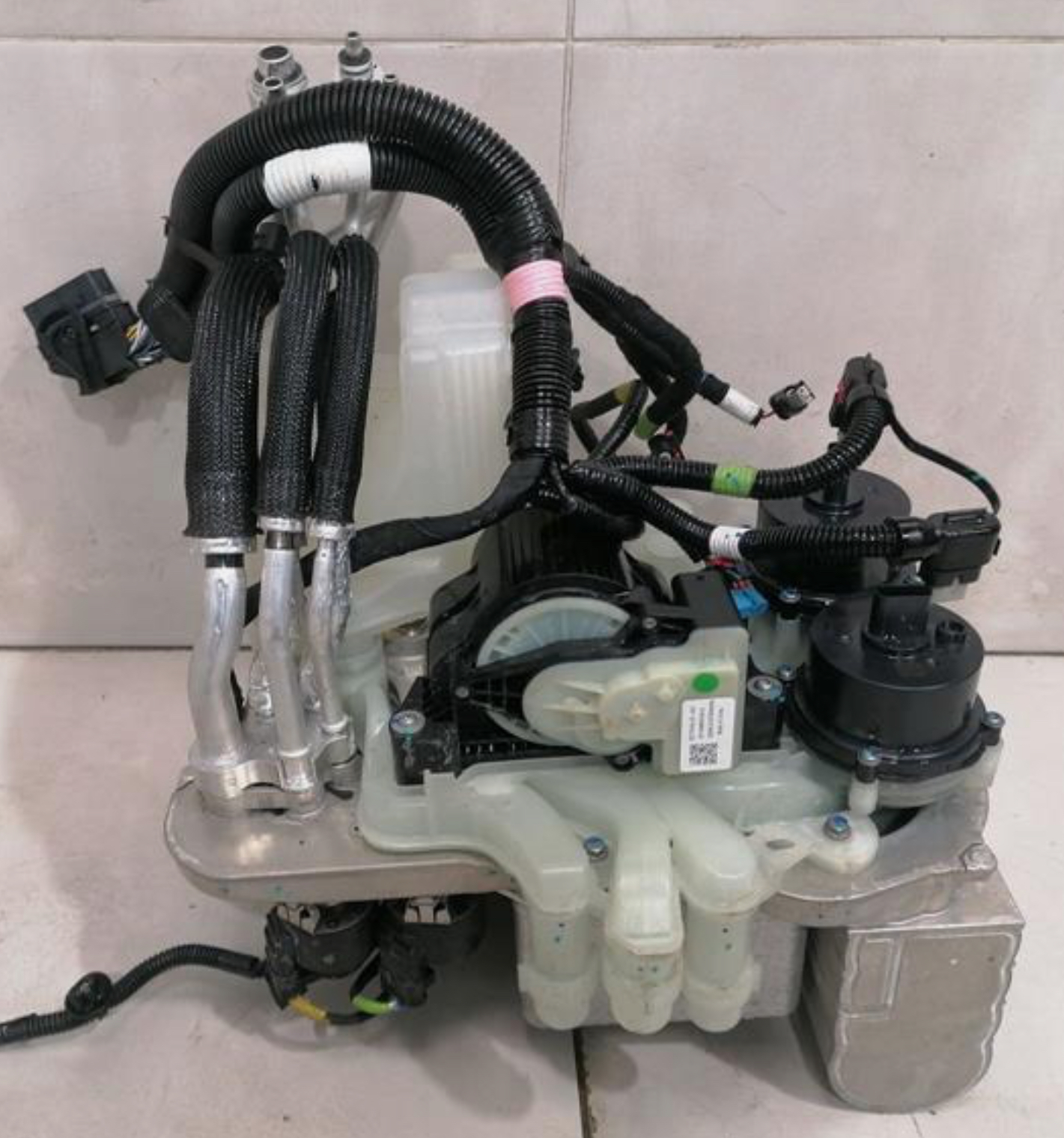
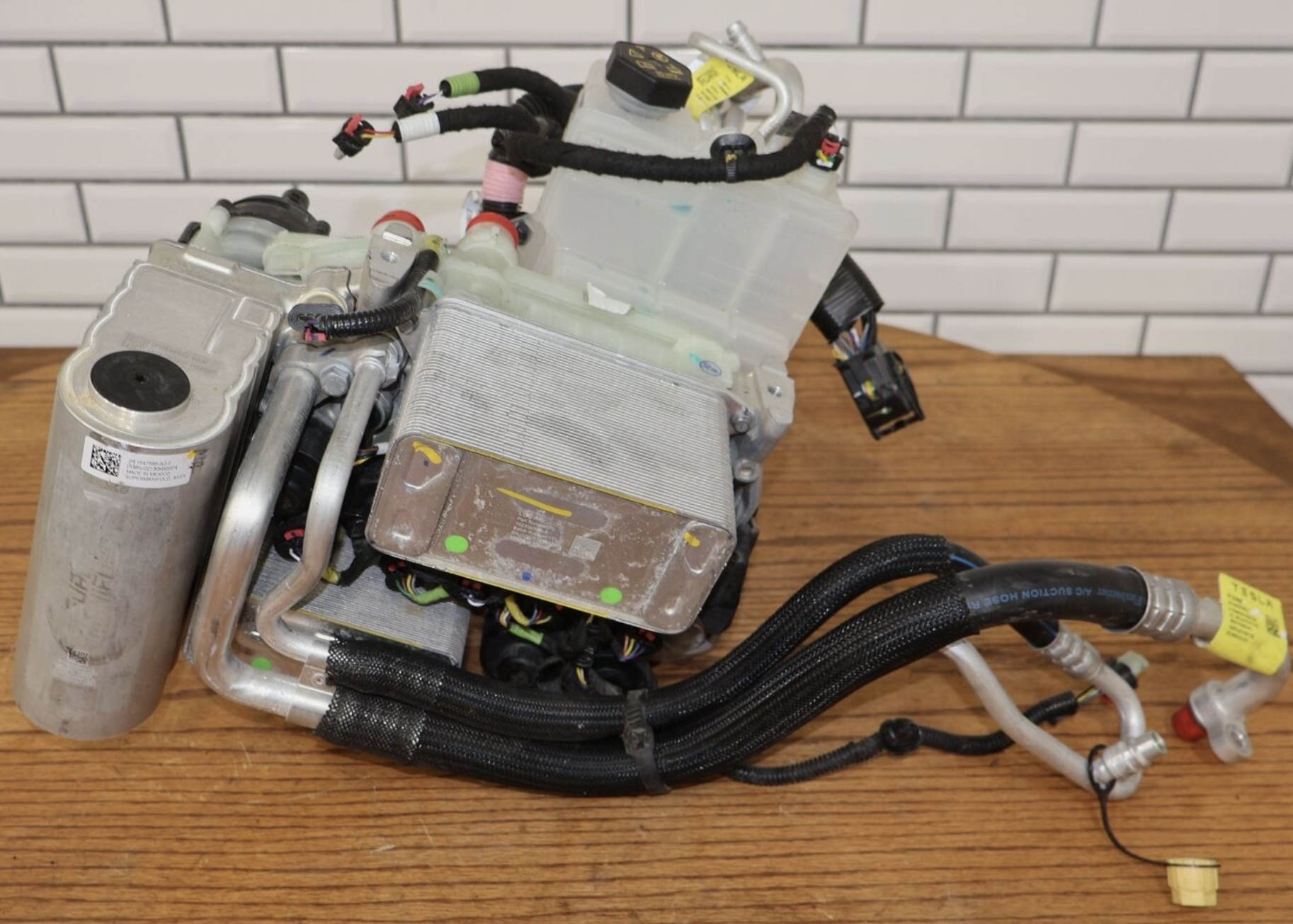
So they lent us a Model S for the night and we stayed in a nearby motel. They got us back on the road before noon the next day. Free. The root cause of our problem was a gasket partly obstructing the coolant supply pipe to the rear motor, which caused that motor go over temperature whenever it needed a lot of cooling. Like at high speed for long intervals in warm weather. I suspect that this was a manufacturing defect that was only revealed three years after the car was built. We had no further turtle alerts on our trip, or since then.
That day we drove for hours across Texas cattle country, passing armies of huge windmills all the way to the horizon, interspersed with bobbing oil pumps. My car was powered by the wind, not by the pumps. It suddenly felt like the future.
“Other than that, Mrs. Lincoln, how did you enjoy the play?”
So on the evening of Day 7, we arrived in Amarillo, Texas and took stock. We had one driver and no cruise control. Range projections had been pretty accurate for the last two days, but we still watched them with suspicion and no real trust. The coolant problem had been harrowing, but there was reason to believe that it had been understood and fixed. Time would tell. So … we kept going and had a vacation.
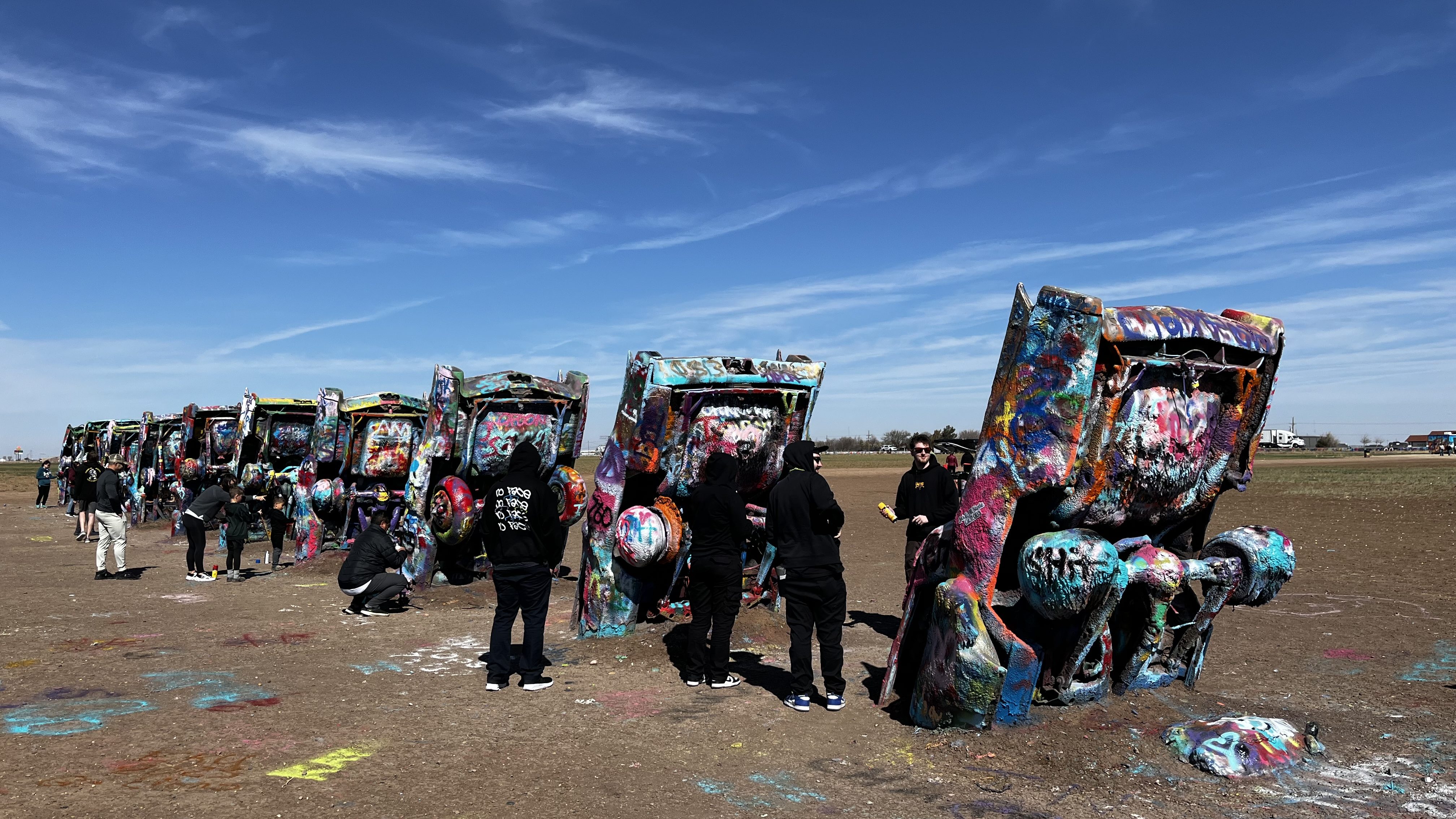
I know I promised not to harp on the sights of the USA, but next morning we visited an ironically appropriate exhibit: Cadillac Ranch. It was a chill beautiful morning, as if God had just unwrapped a brand new Earth. As we strolled toward the planted, painted cars, the perfume of new spray paint wafted on the crisp air. I said to Bridget, “I love the smell of Krylon in the morning. Smells like … victory.” She rolled her eyes.
Epilog
It was a real vacation and we saw many famous sites and did many long-desired activities. It was “the trip”. After 35 days and 10,000 miles, we arrived home again, very gratefully. In the ensuing weeks and months, we processed our experiences. It helped that the Tesla behaved impeccably once we were home. No turtle alerts. No mysterious range drops. I cautiously tested the cruise control on my own, making sure to use it only when there was nobody behind me. No more phantom braking. Maybe the boffins at Tesla HQ fixed it in one of their frequent software updates. But Bridget still won’t drive the car.
We started thinking of places that we didn’t go, either because they were out of charger range or too far off our path. We might set forth again some day on a different route. In Bridget’s plug-in hybrid RAV4.


 If I knew what I was doing …