
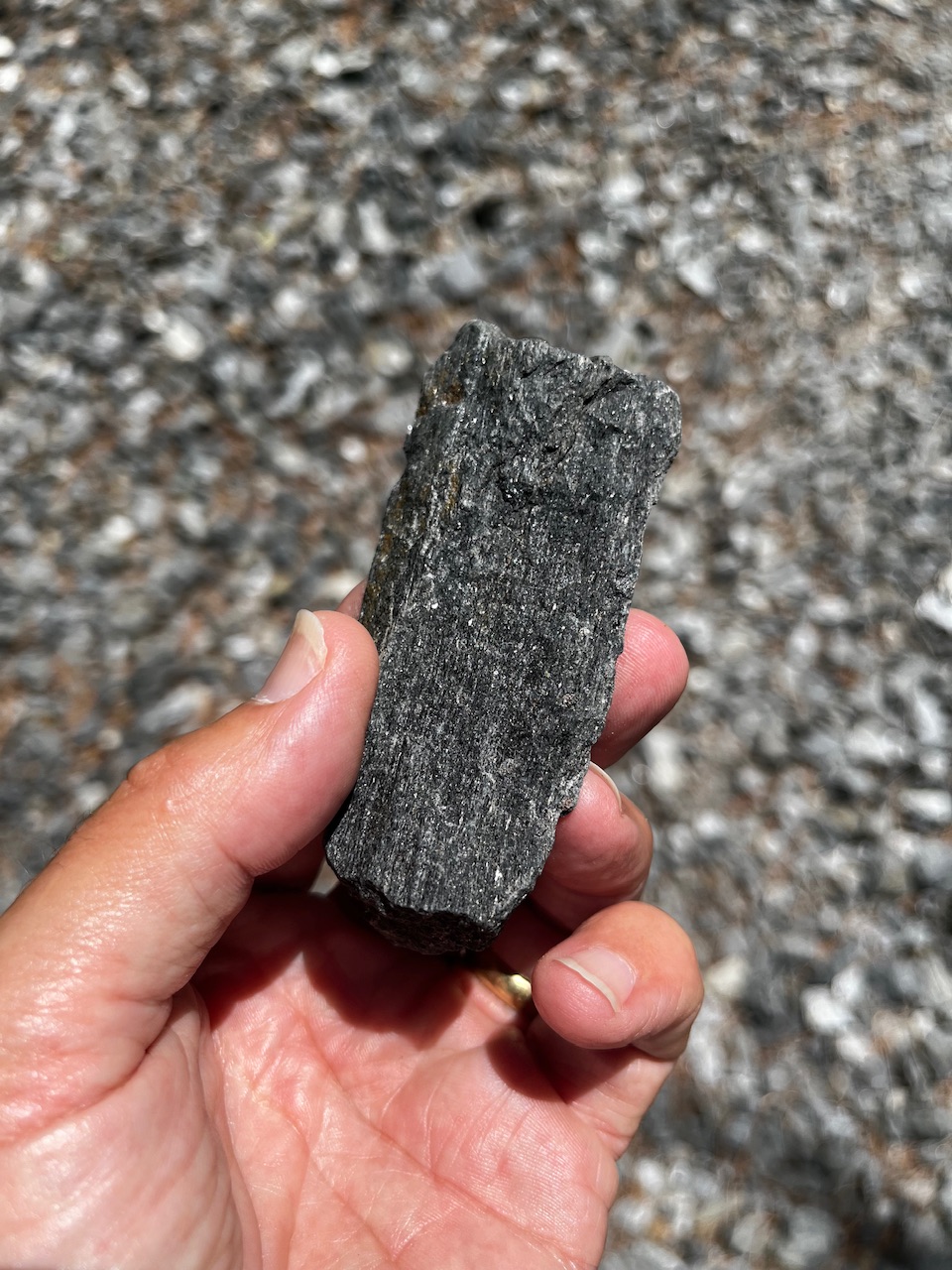
I was hiking on Mt. Wachusett the other day and the service road I that walked on had been recently refreshed with a thin layer of crushed rocks. They glittered attractively in the sunlight and I picked one up. As I went on, I reviewed in my mind the immense history that a geologist can read from this one rock. Come with me, Gentle Reader, on a tour of the distant past of the place that I was hiking upon, and look with me into a deep chasm of time whose events can be known from just one rock.
Almost now
This rock is jagged and it was found loose in a small patch of others that are similar. The first thing a geologist might ask is, “is it in place?”, meaning has it just loosened from the bedrock that is here? Obviously not, since the road is not on any exposed bedrock of the same appearance. Let’s not beat around the bush—it was surely transported here by humans from some quarry. Economics suggests that the quarry is not more than 50 miles away, because why spend more money to get road rocks from farther away? After all, it’s not Carrara Marble from Tuscany, like you might like to have in your bathroom. It might be from a nearby quarry in Littleton; I haven’t been there, but I think this sample looks like rocks from that area. In any case, we can trust that it comes from nearby and was coarsely crushed by human machines, not by natural processes. That means that the history it can tell us is relevant to this region, but not to this specific spot where I found it.
“Quick Sherman, set the WayBack machine …”
A geologist would immediately identify this rock as “biotite schist”, a term which, when converted into English, means “baked mud”. (Yes, like a mud pie in the oven … but for many millions of years.) Biotite is all the glittery bits, tiny crystals of brown mica, about the color of Coca-Cola. (Am I hot and thirsty on the trail?) Chock full of biotite pixie dust, this rock is very pretty in real life, but somehow my phone camera isn’t doing it justice. (Too smart, I guess.) That mineral wasn’t in the mud originally, but it forms from clay minerals by heat and pressure, so the visible biotite is how geologists immediately know that baking happened to this rock. Schist is not a scatological term, it’s from the same Greek word that gives us “schism” or splitting, which the rock does more easily in one plane because most of these mica flakes grew in the same orientation, due to the pressure being strongest in one direction. (It’s always stronger along some direction and the mica crystals will grow perpendicularly to that.)
So where did this mud get baked? There’s only one answer; a dozen or so miles beneath us. At that depth the Earth is a pressure cooker, everywhere around the globe. It’s hot down there because the whole planet is hotter inside, and there’s lots of pressure down there from the weight of miles of bedrock above it.
I can’t resist a really cool digression, or more accurately a hot digression. Why is the Earth hot inside? In the 19th century, they supposed that the Earth was still cooling off from an initially molten state. They were right that the planet started out molten and they knew why, too. Gravity. The bigger our growing planet got, the harder the new pieces fell onto it, each falling and landing with a big wallop of energy. Although this happened over a long interval of time, there was nowhere for the energy to go except to heat up the planet until it glowed like a space heater. So scientists tried to calculate the age of the Earth by estimating how long it would take to cool down to today’s internal temperature. The age that they got was way too short. This was an unsolved problem until radioactivity was discovered in the 20th century. The reason the Earth is still hot inside is the continuing radioactive decay of primordial elements like uranium. Hah! We live on a gigantic nuclear power plant! Geothermal heat IS nuclear power from the planet itself. But before you decide to buy lead underpants, please realize that the radioactive elements are distributed as small traces throughout the planet and that hundreds of miles of rock is a great absorber of radiation energy, much better than lead underpants. And that’s why our planet is still hot inside today. There is enough trace uranium in many rocks to use those tiny amounts to date the formation of those rocks, and even the formation of the planet. End of digression.
Back to the sample of baked mud in my hand. This rock must have been on quite a journey. Mud forms on the surface, cooking happens some miles down, and then rock quarrying happens on the surface again. How did this rock get buried deeply enough to cook and then later get back up to the surface? The evidence that it made such a journey somehow has been obvious since James Hutton founded modern geology in the late 18th century, but the mechanism only became clear during the plate tectonics revolution in the 1960’s. To wit, the mud got trapped in the middle of a collision between two continents, where the crumpling edges happened to shove it deeply under new mountains like the Alps or the Himalaya. Mountains crumple down as well as up; they make deep roots as they rise. We no longer see the mountains that buried our rock because they have long since worn away in the rain and the rivers and have become sand and mud along the coast and offshore. All that’s left are the mountains’ roots, which rose back upward as the weight of the overlying mountains was worn away. And here’s our schist revealed, like Julia Child taking the soufflé out of the oven after hundreds of millions of years. (Dinosaurs were just big alligators with pretensions of grandeur when Julia put this mud into the oven.)
When I talk about burying and cooking mud, there’s a bit of poetic license that I need to confess to. It was a two-stage process. First the newly deposited mud was buried by more mud, like a rugby player at the bottom of the pile. Over time, the layers could build up for a few miles of thickness, where the pressure at that depth would squeeze out most of the water and cement our bit of mud into mudstone by pressure-welding the little mud grains together. But that’s not enough heat or pressure to chemically create the biotite crystals. So in stage two, the mudstone must have been forced much deeper by what could only have been a mountain-building continental collision. For geologists, the biotite is a kind of smoking gun for that event; maybe they should have their own TV show, CSI:Earth. I’d watch it.
So just seeing the biotite gives us this immense history, almost unimaginably long and dramatic: “Himalayas” were once made right here in “New England” by a tectonic collision, but they’ve all washed away! Seems like an eternity. But the next obvious question opens up an earlier, equally stupendous episode of time: before it was baked, where did that mud come from?
“Get back to where you once belonged”
Where does any mud come from? Mud is made up of small fragments of some prior bedrock that was crumbled by weathering and ground up and transported downhill in a river. We know that the fragments were in a river because they have been sorted by size. As the river slows down at lower elevations, it drops smaller and smaller components of its suspended sediments. Mud is made of very small fragments, which are mostly deposited toward the mouth of a river, near or below sea level. (Think Mississippi delta.) But rivers flow from high elevation to low, so the source bedrock for the mud was in hills or mountains. The composition of the particles of mud is the composition of the hills or mountains that were wearing away. Mud is wet mountain dust.
Back to my chosen rock. (This is where the other shoe drops.) So far I have failed to mention the most obvious characteristics of the rock in my hand. It is dark colored and heavy! This almost always indicates the prominent presence of iron. What kind of source hills and mountains are made of iron-bearing bedrock? Volcanoes! And not all volcanoes, but specifically volcanoes of an island arc, such as Japan. So the mud of the rock in my hand was once washed into a sea from a volcanic island arc that was once nearby this location, then the mud was buried by more mud, then turned to stone, and then cooked under the later mountains of a continental collision that erased the sea; then those mountains also washed away, revealing this rock to a wandering, wondering primate.
Sounds like a wrap-up, doesn’t it? Cue the organ music and pull back the camera? “But nooooo”, another even earlier epoch beckons us. We can still ask, “where did the magma that spewed from those volcanoes come from?” And we can answer with confidence.
“Once more into the breach”
Volcanic island arcs form when one plate of ocean crust dives beneath another and into the hot mantle below. It’s called “subduction”. (Not seduction, subduction—”pulled under”. My favorite geology t-shirt says, “Subduction leads to Orogeny”—orogeny means mountain-building, not the building of sexual tension. Who says scientists have no sense of humor? Well, yeah … it is pretty lame. Maybe you’re right.) The waterlogged down-going ocean plate slides down deep into the oven and melts into buoyant, runny magma, which rains upward in the mantle, collects under the crust, and then melts through the overlying plate—et voilà, a row of volcanoes forms parallel to the subduction trench. We see this today. So the atoms of my rock were once part of a sea floor that dove into the mantle not far from here, then melted, then spewed up out of a nearby volcano. That’s our third step back toward eternity. Are we done looking backward in time? No, not even yet. Where did the sea floor come from before it was subducted, melted, volcanoed, washed away, buried at sea, collided, baked, eroded up to the surface, quarried, crushed, strewn on the road, and picked up by me? (It’s getting to be like that old song, “there was an old lady who swallowed a …”.)
“… a sea change, rich and strange …”
The answer is that, unlike continents, all of the ocean floor is a conveyor belt of bedrock, welling up from the mantle, traveling along under the sea, then diving back down again. The oldest ocean floor anywhere in the world is less than one tenth as old as the continents. In the 1950’s, the US Navy mapped the sea floor with sonar and magnetism because it was a new Cold War battlefield for submarines. (And you thought they were doing it for science. Hah.) Beneath the waves, they discovered enormous linear ridges running around the planet at depth, with symmetric magnetic stripes on either side. This was utterly incontrovertible evidence that the sea floors were spreading from those long, long sutures. So the ocean crust must be diving away elsewhere—in the trenches near islands and continents! It was a revolution in thought that explained everything in geological history—just like evolution explains everything in biological history. The atoms of my rock came up from the mantle at some spreading center, perhaps very far from “here”, traveled along the sea floor, then dove under another plate near “here” before melting and coming out of a nearby volcano.
And at last, this is as far back as this one rock can take us—unless we want to visit interstellar space before the Earth was formed, but that’s another story. These atoms in the rock in my hand, came originally from deep within the Earth, became part of an ocean floor at a spreading center somewhere, which traveled along until it was subducted near “here”, melted, spewed out of a volcano, hardened, washed into the sea, buried to make mudstone, cooked deep in the Earth under the mountains of a later continental collision that erased that ocean, was buoyed up to the surface again as those mountains also washed away, was hacked out, crushed, and strewn on a nearby path by some industrious animals, and was recently taken home in my pocket. So much can we tell about the past of New England from just one rock.
Deep time
This story illustrates how geologists see the world differently from the rest of us. When they look at a rock or a hillside, they are staring into an almost unimaginable abyss of time, an abyss in which the world moves in a time-lapse hallucination. Continents barge through the ocean crust like cruise ships, colliding with one another and throwing up Himalayan fender benders, which wash into the seas almost as rapidly as they arise. The continents carry an ever-changing Noah’s ark of species, exuberantly evolving without cease. The sunlight endlessly pumps water into the sky from the seas, and the rain endlessly pours it back down and wears away every mountain as if it were sandblasting it. The greatest rivers and lakes are as ephemeral as the rivulets running down your windshield, yet all the mountains are washed into the sea by those endless rivulets. And our whole species shows up in just the most recent blink of an eye. But within that eye-blink, we have time to look back and piece together the story of the immense grandeur of our planet’s past. Science … is literally awesome.
To see a World in a Grain of Sand
And a Heaven in a Wild Flower
Hold Infinity in the palm of your hand
And Eternity in an hour
(Auguries of Innocence – William Blake, 1803)
As I walked on Mt. Wachusett, I held infinity in my hand. And knew it.


 If I knew what I was doing …